Friday, February 29, 2008

Desert Oasis


We arrived in Jaisalmer on February 18th to a miniscule airport in the desert. Our hotel was an ancient, labyrinthine building and our room admired the timeworn fort perched on a narrow plateau. The furry-eared receptionist informed us that it was the week of the Desert Festival and the events were free and open to everyone, featuring such events as a turban-tying race, moustache competition and camel polo. The atmosphere of the town was relaxed and rhythmic with a feel of pervasive history.

As we explored the town the first evening, we saw traditionally-dressed men with their heads wrapped in turbans or scarves and women with traditional jewelry and nose rings. As we walked, bulls wandered through the streets and vendors were selling food and fabric. After wandering for a bit, we had lunch at a haveli (a northern Indian or Pakistani private residence, which in Jaisalmer are mostly stone with incredible ornate carvings on the outside) on a veranda which looked like something from Indiana Jones. Then we arranged an overnight camel safari before finding the best chai(delicious tea) and thalis (set meals sampling several dishes served with bread and rice) in town.

The following day was Matt's 24th birthday, so we both slept in late. After running several errands, we tried and failed to see part of the Festival, then had a moto-rickshaw drive us around to several famous havelis and up into the historic fort. We ambled for a bit through ancient alleys and accidentally beautiful sights (kids playing cricket in front of a temple, brightly painted front doors set in timeworn stone walls, and dozens of shops displaying bright jewelry and fabrics). Then Matt had a chance to talk to his girlfriend before dinner and festival fireworks.


The next day, we were up early and packed, heading to the Dedansar Stadium (a large expanse of sand with a wall on two sides, a hill on another, and several tents set up with chairs to watch the events) for several festival events. There were a few thousand people attending the festival, ranging from desert nomads to VIPs from all over India and world tourists scattered throughout. People were sitting under tents, buying snacks, listening to bands practice, hiding from the scorching desert sun, admiring the beautifully-decorated camels, and strolling the grounds. Eventually, the program began and we saw wrestling competitions, camel decorating contests, camel polo (Matt's favorite, especially after we narrowly missed elephant polo in Nepal) and a camel race (my favorite). The camel race did NOT consist of men on camels racing from point A to point B. Rather, it began with several men standing behind a line in their underwear. When the starting gun fired, the men ran 10 yards to their dhotis (wrap pants) and shirts, and rushed to get dressed, then they ran another ten yards to a cloth which they tied into a turban, next they had to run to saddle pads and carry them to their camel, then run back and grab the saddle itself and carry that to the camel. The man who got dressed, saddled up, and up on his camel first was the winner. To see a video of this thrilling race, please click here.


After a bit of the festival, we headed back to town, hopped in our arranged Jeep and headed out to meet our camels in the desert. We arrived in the middle of nowhere to a small hut where two men and a boy were sitting in the shade. The boy came right up and introduced himself, saying he would be our camel safari guide. I giggled and humored him, only to find out five minutes later that he was he was our guide and the only one who spoke English. Hussein and our elderly camel-tender, Metan, had us (after the all-important glass of chai) hook our bags to the saddles and climb onto our camels (mine was named Jodah) who then groaned and stood up jerkily. The next few hours were spent bumping along in the saddle, wrapped up from the sun, through villages and scrubby flatlands, and eventually into dunes.


When we reached the prescribed location, we all dismounted our camels and Metan and Hussein set up camp while Matt and I explored the dunes as the sun set. We spent the next several hours chatting with Hussein, drinking chai, running around the dunes, and singing to each other around a campfire in the sand. It was a beautiful evening and a wonderful sleep under the stars.

The following morning, we had breakfast, brushed our teeth and talked to the camels before travelling again (to see the groggy wake-up video, please click here). We were plodding along for a few hours before we came to a small village where Hussein had us dismount and enter the compound. We met a dozen kids and several adults, all in traditional garb. The ladies did not want to be photographed, but they wore quarter-sized nose piercings, and large, silver jewelry, and they dressed in colorful saris. I am certain that - besides more advanced wells and portable cooking gas tanks - they live the same way as their great-grandparents, gathering animal dung and brush for fires and raising goats for milk, meat, and money. After a lovely visit and some chai, we headed back out on the camels, eventually arriving at the Sam sand dunes. At the dunes, we bid a find farewell to Hussein, Metan and our camels and struck out to find the focus of the final day's festival events.


There was a period of over an hour, as we waited with the crowds, when the camel races were postponed due to blowing sand. At last, the wind calmed and we saw several groups of camels race each other over a quarter mile. The onlookers were concentrated around the finish line, and at the finish of every race, many had to run for safety to avoid being trampled by the speeding camels whose momentum refused to allow them to stop. We spent time with the crowd in the dunes and watched the concluding ceremonies under the light of the full moon before heading back to town in the Jeep.


The next morning in Jaisalmer, we were up early to make the most of our last hours in the lovely town. Matt and I headed up to the fort together but then split up to indulge our individual agendas. I wandered through the alley shops, testing the local vendors to find a bedspread at the right price (if you've been reading, you're aware of my unaccountable sadness when I was unable to purchase a bedspread of tribal cloth in Thailand). The state of Rajasthan is famous for its beautiful fabrics, with contrasting patterns patched together, complemented by embroidery and sewn-on mirrors. Eventually, I found the perfect one and forked over the cash before running around to see the Jain Temples, then meeting up with Matt, grabbing a moto-rickshaw and flying to Jodhpur, then Delhi. In Delhi, we took an overnight train and were delighted to share our cabin with a mother and her five-year-old, both of whom spoke English. We talked for hours with the mom and played with the little one until it was time to sleep. When we woke up, we were in Bombay.


The pictures in this post are: sunset camels in the dunes, a winding alley and shops inside the fort, boys dressed up to perform for the Desert Festival, my boy Jodah, me and the group trudging through the desert, a windswept dune, the sun setting, the post-sunset colors over the dunes, me and Jodah under the moon (depending on your display, you might not be able to catch this one), beautiful children, myself (looking like a dork) with Metan & Hussein and the camels, Desert Festival crowd (please open this picture and have a look at the crowd stretching up onto the dunes) , and my new prized possession.

Sunday, February 24, 2008

Varanasi & Bodhgaya

Matt and I had heard a few tales of woe about travelling in India before we arrived in the country, and a few more specifically about Varanasi. The town's backpacker nickname is "very nasty" and our first taste of it was just that.

We hired a pre-paid taxi upon arriving at the Varanasi airport since pre-paid tends to be more reputable and safer that hiring a driver at random. Still, the driver tried to charge us for "parking fees" then repeatedly told us that our hotel was very expensive and he would take us to his, "no problem." When he stopped the car in the city to let his friend get in with us, it was the last draw. Matt had been feeling under the weather and hadn't slept well in several days and politely shoved the driver's friend out of the car and loudly scolded the driver who stopped messing around and took us to our hotel, but not before asking for a tip.

Since all of the decent hotels were booked full, after numerous phonecalls we had to settle on an empty, run down apartment. The hotel staff tried to overcharge us for the room we had booked, but eventually they relented to the price we had agreed upon. I spent that day poking around the town while Matt laid in bed resting and trying to recuperate. (I even bought him a cheap watch for his birthday. since we NEVER have time apart, this was a golden opportunity and we needed a watch anyway, but now he's started wearing one he had in his pack, so I have no good present afterall) We stayed at our mediocre hotel and accomplished very little that day.

The following day, we were finally able to reserve a room at our desired hotel. While re-packing our belongings to move, we realized our cell phone was gone; we had either misplaced it or someone with sticky fingers decided it was theirs. We gave up on it and hired (overpaid) a rickshaw to take us to the ghats, where we were dropped off in an alley, then had to follow a child through winding backstreets to our new hotel. When we arrived, it was 2pm and they had already given away the "reserved" room since I had specified on the phone that I would arrive at 1pm. AAAaaaahhhh! Finally, Matt and I took the only room they had available, for $5 a night, with shared squatter toilets, and shared cold showers. Then we had a late lunch, which was pretty delicious, and things began to improve.

After our meal, we took a boatride (video) to explore the holy Ganges River (spelled Ganga and pronounced gahn-gah in India). The Ganga is sacred to people of the Hindu faith and it possesses many powers. Bathing in the waters can cleanse you of your sins and having your ashes placed in the waters can send your soul to Heaven. Despite the river's importance, it has innumerable sewers, agricultural toxins, and city water runoff emptying into it. But the Ganga is called the "Holy Mother", and the water is so sacred that people rinse with it, bathe in it, collect it, and even drink it. And certain bodies, which for spiritual reasons may not be cremated, are frequently placed in the river in their entirety.

"In Varanasi, India's most sacred city, the coliform bacterial count is at least 3,000 times higher than the standard established as safe by the United Nations world Health Organization, according to Veer Bhadra Mishra, an engineer and Hindu priest who's led a campaign there to clean the river for two decades." (Smithsonian, 2007)


Though we were in Varanasi for several days, we were trying to absorb local culture more than to visit tourist sites. Though I might not effectively put in to words all that we accomplished, we did see alot of Varanasi and came to really admire it. We made some traveler friends (Justin and Erika) from NYC while we were in town and had dinner with them three nights in a row. The third day was spent exploring the town by wandering the back alleys and main streets. If you have time for a 30 second walk, please check out this video.


We spent a significant portion of the fourth day at the train station arranging a trip to Bodhgaya, before returning to the river for a walk along the ghats. That night, a large portion of the young male population were partaking in rowdy, colorful, religious devotions (puja) involving pop music while frantically dancing through the streets, following an icon of Vishnu.

The following morning, we were walking through the alleys loaded with our packs on at 4:30 AM and there were a surprisingly number of people awake, brewing their tea, brushing their teeth and otherwise beginning their day. We successfully caught a rickshaw and got to our train platform in a hurry before discovering the train as delayed for an hour and a half. We met some other travellers and chatted with them for ages while drinking numerous cups of chai.

After a long wait and a longer train ride, we arrived at our stop and caught a rickshaw to our next town which was lovely. The Sakumuni Buddha achieved enlightenment in Bodhgaya around 500BC and it has become one of the most famous Buddhist pilgrimage sites in the world. The utter devotion of the people in the town is inspiring and the town itself was beautiful and relatively calm. For some odd reason, all the children want to speak with foreigners to practice their English and we made many young friends while we were in town. Unfortunately, there are an inordinate amount of beggars because Buddhists believe you can improve your karma by giving, so the beggars know to come to this pilgrimage site.

The Mahabodhi complex is the main religious site in town, containing the Mahabodhi Temple and a Bodhi tree grown from a cutting of the original, under which Buddha became enlightened (to investigate further into the religion, please check out the BBC website on the topic). The first evening during lunch, we met a few little boys who wanted talked to us about our country, our ages, cricket, school, etc. Many children spoke to us while we were around, but these children from the first evening kept criss-crossing our path and we returned many times to their family's tea shop. There were about a dozen people in the family and all the kids were filthy but adorable, they spoke good English, and they never asked us for anything except to come by the shop.


During the days we spent in Bodhgaya, there was a chanting ceremony taking place and monks from all over Asia were in town, dappling our vision with orange, red, yellow, and mauve . If there are people in this world striving too attain enlightenment and a perfect peace, then that kind of peace must be a possibility. I particularly adore the child-monks, with their young faces and serious expressions who make me want to run and hug them. The chanting during the festival was so rhythmic and coming from so many people simultaneously that it had an amazing power. We spent at least twenty minutes sitting cross-legged outdoors riveted to the sounds, trying to absorb some of the passion that these monks were chanting with. It was almost as if they didn't have to speak the words for us to hear them.

The second day, we explored more of the town, seeing temples built be people from every country or region in Asia, with their own architecture. The straight lines and golden deer from Tibet, the golden, pointed temples from Thailand, and the dragons and sweeping rooflines from China served as a Buddhist review of our trip. Right at sunset, we came around a corner to find a giant Buddha statue with the sun setting behind it. We admired the rainbow of colors while sipping chai (we've become chai addicts on this trip and it's so cheap and delicious, I can't seem to find a problem with it yet). The third day we spent a couple morning hours on Valentines Day conversations before wandering around in town, strolling about the outskirts, checking out the lotus pond, (during this afternoon Matt caught a goat. Please check the link to his blog on the right to see pictures) going out of our way because the president's motorcade was coming, and spending time with our adopted family. The last evening in Bodhgaya, we sat down with our family for a while and handed out some hygiene items and a couple issues of Newsweek, learned some Hindi song lyrics, and generally chatting before it was time to get a moto-rickshaw back to the train station.


The following morning, we were back in crazy Varanasi. We had a chance to catch up on a bit of sleep, do some laundry (please check the video), wander around and get lost, finally locate dinner, and finally put some good time into the Delhi blog post. The following day was ridiculous. We hopped a flight and arrived in Delhi with too much time before our next flight to stay in the airport, but not enough time to go anywhere else. When we arrived, we picked up our bags and went searching all over for an internet cafe (Matt has a great picture of the two of us in a crowded, crumbling alley pushing the luggage cart that we borrowed from the airport). Frustrated and unsuccessful, we returned to the airport dragging our cart and resorted to pleading our case to the airline representative. She gave us passes to the airline lounge which turned out to be a bare, public restaurant. But I only know that because I searched for it out of curiosity. You see, when we accidentally showed up at the fancy lounge by accident, lugging our bags, completely frustrated, we must have looked quite pitiful because the receptionist there let us stay, though she turned many others back out. There, we found delicious finger food, plush couches, free internet, and all the tea we could drink.

The pictures in this post are: the holy Ganga River, daily activities at the ghats, a sign reading "fortunate are the people who reside on the banks of Ganga" painted among filth, vendors selling bangles and other necessities, a busy row of Varanasi's famous silk stores, monks participating in the chanting ceremony at the main temple in Bodhgaya, the main temple at sunset with a golden Buddha statue glowing inside (zoom), and the family who Matt and I befriended and won't forget.

Friday, February 8, 2008

Delhi and Agra

Matt and I arrived in Delhi during the wee hours of February third. Mr. and Mrs. Ericson (the parents of my dear friend, Katja) welcomed us into their home and we fell fast asleep until noon. When we finally emerged, the Ericson's unofficial-family-member / driver, Sanjay, showed us the highlights of New and Old Delhi including stops at the Jama Masjid and the Red Fort. The Jama Masjid is the main mosque in Old Delhi, and it was prominent, but the market outside was what really drew my attention. It was bustling with vendors and patrons bundled up with colorful scarves and saris looking for the perfect deal. In the air, the summons of vendors mixed with the call to prayer being broadcast from the mosque (video). Returning home after our day of touring, Mr. Ericson took us to dinner at a South Indian restaurant. The food was unlike any that I've tried before and I'm looking forward to time along the coast to try these savory dishes where they originated.

The following morning, we were rattling down the rails on a train to Agra. Matt and I have picked up a habit of phoning hotels immediately before arriving in the city instead of a day or two in advance, and we need to remedy this habit right away. We called from the train and wandered for about two hours inquiring in lobbies before finding a decent, available hotel room. The only activities we had time for that night were dinner and a haircut for Matt (in an alley shop with a dull, grade-school scissors) before bed.

We were outdoors before the crack of dawn the following morning to see the sun rise on the Taj Mahal. It was chilly, but we had a great view, and after maneuvering some inconveniently-placed decorative flowers, we had a tripod spot as well. The sunrise was gray and hazy but still magnificent, as it unveiled the massive marble monument. We wandered around the grounds for hours, in awe of the architectural masterpiece in front of us.


The central building was amazingly detailed, with ornate flowers cut from precious and semiprecious stones embedded in the translucent white marble around all edges of the walls. There were also latticed marble panes and Arabic script engraved above the entrance. The Taj was built by Emperor Shah Jahan as a mausoleum in tribute to his favorite wife and is widely considered one of love's greatest masterpieces. The single detail that renders the building non-symmetric is his own tomb, which is located just to the side next to hers which is much larger, and in the center of the main room.

We spent ages admiring the main building and all of the surrounding structures, architectural elements and landscaping. It was an absolutely breathtaking area and every detail could be scrutinized and appreciated. I must have spent at least 20 minutes just staring at the multitude of stone flowers. Although the shape of many were similar, the grain of the different stones provided each with its own identity and the contrasting colors of the many crystals made each stand out. (the interior picture was taken secretly since they're not allowed, so it might be fuzzy. to see the individual stones, enlarge the other shot)


After reluctantly withdrawing from the Taj, we headed to the Agra Fort. The fort has existed in its current position for over a thousand years, but did not achieve its status as an architectural masterpiece until after it was rebuilt for King Akbar in the 1500's. When his grandson, Shah Jahan (of Taj fame), had the throne years later, the Shah converted the fort into a palace. Shah Jahan's usurping son later commendeered the fort and imprisoned his father in a room with a clear view of his beloved's mausoleum. Like many of the tourist sites we have visited in developing countries, this was another where you can touch everything, nowhere is off-limits and you're free to wander wherever you want. The only area we didn't thoroughly investigate was in the outer courtyard where we were turned back by a furious monkey who wanted Matt's Coke.


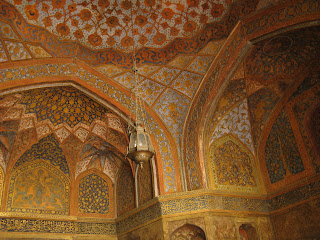
Following the fort, we headed to Akbar's Mausoleum where we were greeted by a strange array of hosts (video). The mausoleum was beautifully constructed and although not as massive or highly detailed as some of the other structures we had seen, the internal paintings were an incredibly colorful and intricate. When we had investigated the sight for awhile, we met a mother and son outside and traded a pair of toothbrushes for some pictures and nonverbal conversation. Then it was time to take a tuktuk the train station and head home to Delhi.


The following day, we headed to the National Museum, which was spectacular. The most interesting section was from the Harappan Civilization along the Indus Valley (wiki). The civilization flourished five thousand years ago and had technological advancements that are lacking in many developing areas today! First of all, the cities were constructed based on urban planning and they had plumb bobs which show attention to construction. They had water storage systems and wastewater drainage and they cultivated crops. Clay children’s toys have been found from the areas and there is evidence of extensive international trading.

We spent several hours at the museum and the guards had to turn off all the lights and lock the doors to make us leave. We seem to shut down museums all the time. After a brief wander, we met up with some friends of Matt's at Connaught Circus. They happened to stop briefly in Delhi as an excursion away from their boat while sailing around the world. To learn about their trip and its educational goals, check their website. We ended up having dinner and a couple of beers with them before heading back to the Ericson's house.

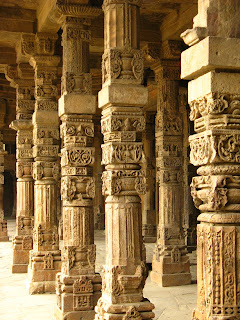
The following morning was a bit lethargic, that is to say, the Ericsons have soft beds, hot water, a coffee maker, a laptop, and BBC news on cable. I would like to come clean and say that all of our mornings were a bit delayed by the welcome presence of creature comforts. After our lazy morning, we headed to Qutb Minar, a tower built by the first Muslim leader of Delhi. The tower's immense height (72.5m) and its age (built in the 1100's) are the reasons for its fame, but they're not what I most enjoyed about the complex. Ever since Angkor Wat, Matt and I have developed an affinity for crumbling stone structures and the buildings surrounding the Qutb Minar provided us with just that. Also on the grounds is a pillar, made of 98% pure iron, erected in the Fourth Century AD which has withstood the ravages of time without rusting. It seems to be an anomaly and I was utterly fascinated by it due to my engineering background. But I won't bore you talking about metal poles.

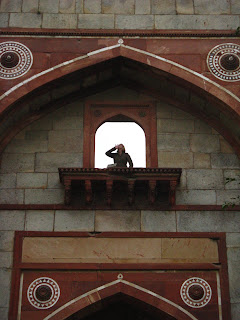
After Qutb Minar, we wandered the grounds of Emperor Humayun's Tomb for a while. It was built in the 1560's AD in the same Mughal architecture which defines the Taj Mahal, which was constructed at a later date. The grounds were so similar that we didn't spend much time before I got bored and began exploring on my own. I found a lovely balcony and shouted for Romeo but was sorely disappointed when he didn't turn up. Alas. Following our explorations, we went out to a lovely restaurant with Mr. Ericson where I acquired a love of sweet raita (basically yogurt) and tasted properly-cooked tandoori chicken which is not at all dry.


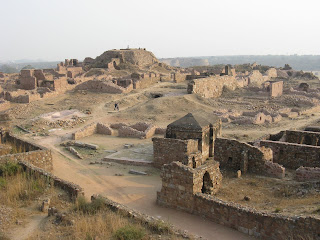
The next day, Matt had acquired mild, flu-like symptoms, and we took it easy. Our first stop was the embassy to have a few more blank pages to our passports before heading to amble through more ruins. The Tughlaqabad Fort was a massive project to serve as the third capital of Delhi under king Ghias-ud-din Tughlaq. However, after a dispute with the king during construction, a saint put a curse on the area (the king had mandated that all laborers in Delhi must come to work on his fort, taking many away from digging the saint's well). Within six years, the king was dead and his son had shifted the capital. The area is more or less desolate today and fun to stroll around in, imagining the glory that could have been.


After our strolling, we headed to the State Craft Emporium (a tame substitute for the local markets due to Matt's feeling crumby) which was quite mediocre, before heading back to the Ericson's where we watched a lovely Indian film named, "Lagaan," which I would recommend to everyone.

The following morning, we were up early to bid a fond farewell to the Ericsons and Sanjay before hopping on a plane to Varanasi.


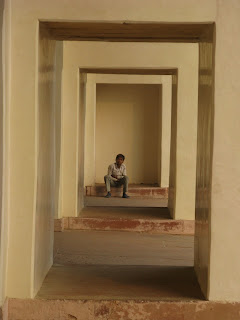
The pictures in this post are: the Taj, me admiring the Taj, exterior stone engraving, interior stone engraving, an angled view of the Agra Fort, the interior paintings of Akbar's Mausoleum, the son we met, ancient columns at Qutb Minar, myself calling Romeo, and the ruins of the Tughlaqabad Fort.

Wednesday, February 6, 2008

Notes on Southeast Asia

These are some observations I've made while travelling around this region:

(These are quick thoughts, definitely generalizations, and
probably stereotypes. I'm just putting them up here to
give a vague idea of how different life is here.)


Hinduism and Buddhism affect all aspects of life for many people,
  • Behavioral norms are governed by religion, such as not patting a child on the head because it's the highest and therefore holiest part of his body.
  • Saffron-robed monks are everywhere. They're on public transportation, in fast food restaurants, talking on cell phones, and scattered about your everyday life.
  • Most Hindu homes and businesses will have a shrine with religious icons which they will "feed," wash, and pray to everyday.

Silk is for sale everywhere in every shape and form.

You see elephants walking down the side of the road on occasion (there's no other way to transport them!) and in all sorts of religious, historic, and cultural imagery


Feet are dirty and low. Don't point them at people, don't step over anyone on the ground, and don't put them up on anything.

Only in expat homes, upscale businesses, and tourist establishments do you see sit-down toilets. The normal custom is squatter toilets and no toilet paper, just the bidet hose. (remember the story about why we always shake with the right hand?)


Here are some differences solely taking place in Thailand:
  • They are centuries ahead of the rest of us. Literally! According to their calendar, the current year is 2551!
  • You must remove your shoes before entering any home, most businesses, and in temples. (We only saw this in Thailand while we were in Southeast Asia. Now we're seeing it in India as well, but you must remove shoes in temples in most countries.)

Thursday, January 31, 2008

Thai Islands

We arrived in coastal Southern Thailand on the evening of January 25th, with nowhere to stay and a laundry list of sights we wanted to see. By the time the following morning rolled around, we were on a minibus to Ko Lanta, which is a large, gorgeous, and mellow island in the Andaman Sea. When we arrived, it took us at least an hour of walking to find a magnificent little $15/night bungalow with an outdoor shower just off the beach. The sun was on the verge of setting while we were checking in, and after a mad scramble to get the packs in the room and pick up supplies from 7-11 (oddly, that store is all over this country) we were on the beach watching the multicolored orb descend into the sea, sipping home-made celebratory island cocktails.


The following day was a magnificent day of relaxation. We spent the whole morning on the beach, swimming, floating in the water, reading, and napping in the shade. We decided that since we were in the shade, there was no reason to apply sunscreen. Whoops. That mistake had implications for 5 painful days. Stupid. Oh well, lesson learned. We really did nothing else that day except relax and watch another sunset. And I finished Life of Pi, which is a glorious book that everyone should read.

The following day, urged on by feelings of guilt over the previous day's lethargy, we rented a motorbike to tour the island. We found a multitude of different size and shape beaches, separated by rocky outcrops, each bordered by a smattering of bungalows or restaurants. It was a blast moving along at our own pace and stopping to examine the beaches on a whim. And, of course, Matt and I both LOVED to drive the motorbike.

Afterwards, we stopped for dinner with Bendigo and Stephanie. I hadn't seen Bendigo since I left Jamaica and it was lovely to be able to catch up with him. As we ate, firedancers came out on the beach to perform and left us spellbound.


The following morning, we hopped the early ferry to Ko Phi Phi, where "The Beach" was filmed. We found the island to be just as stunning as we had heard. Where there wasn't a rocky cliff jutting up out of greenery, there was a silky, white sand beach sinking into translucent teal water.


As soon as we finished checking into a hotel room (think wicker box with no lid, turned upside-down on wooden slats, with no bathroom) I was heading to the beach in my suit with my snorkel. The guidebook referred to the beach we were staying as having "deluxe sand and polychromatic marine life," so I knew I had to get out there immediately. I used to snorkel frequently in Jamaica and became quite fond of it. Tripod would frequently join me on those ventures, but that's another story. It was lovely to get in the water again, and I could hardly believe that there could be such a variety of marine life so close to shore in a tourist area.

As I snorkelled, I saw angelfish, scorpionfish, parrotfish, as well as many others that I couldn't recognize. I snorkelled for about a half hour before arriving at a rocky outcrop where I could rest. There were two other snorkelers there so I asked how they were doing and if they had seen anything good. "Just the sharks," they replied. "Sharks?!" "Yeah, the sharks. This is Shark Point! Were you swimming with your eyes closed?!" As I followed them back towards shore, I made sure to scan the periphery of my vision, instead of investigating the little rocky nooks below me. And sure enough, there were sharks! I saw two black-tipped reef sharks! They weren't too big or too nearby, so I didn't feel threatened. Also, there were several other people snorkeling and if everyone knew the sharks were ravenous man-eaters, I would have been the only fool in the water. Needless to say, I survived the self-absorbed sharks. That evening, Matt and I walked along the beach to the main town where we asked about scuba diving opportunities before taking a boat back to our hotel (There were no motorized vehicles on the island).

The small island of Ko Phi Phi Don (wiki) was devastated during the tsunami. There is sandy isthmus where the shops and sunbathing areas are concentrated and waves met there coming from both sides of the island. Of approximately 10,000 people who were on the island on December 26th, 2004 roughly 2,000 were killed. Over half of those bodies were never recovered.

This is not my picture, it's just an example of a black-tipped reef shark from cyberspace.
This one's an adult, the one's I saw were juveniles.

The following morning, we packed our stuff, checked out of the hotel and had breakfast. Then I was back in the water again since the ferry wasn't until 2:30. And I saw sharks again! About a dozen this time, with the largest looking to be about four feet long. I also saw a tiny octopus (I swam down to make sure) before I had to run back up the beach to leave.

After we arrived in Phuket, we hopped a bus to Khao Lak, where we signed up for the dive we wanted before heading to bed. The following morning, we were up early and on the shuttle (the back of a truck) to the boat. We went out with Big Blue Diving Company to Richelieu Rock, because we heard it was one of the best dive sites around (wiki: Similan Islands). I was anxious at first since the only times I had been diving were as part of my certification over nine months previously, but all my worries floated away as soon as I hit the water. We completed two dives that day and the marine life was gorgeous. I had never been so deep (20 meters!) and the density and variety of aquatic life far exceeded anything I'd seen before.


After diving, we headed back to Khao Lak to shower, eat, and chill out for the rest of the day. The following morning, we were on a bus to Kokkloi, then Krabi where we tried to finish some last minute chores before leaving the country. We were terribly unsuccessful. So the next afternoon when we arrived in Bangkok with an eight hour layover before our flight to Delhi, we headed into the city one more time. We spent a few hours eying up souvenirs, haggling over t-shirts, buying & selling books, and munching on cheap pad thai before heading back to the airport.

We still arrived three hours early for our flight so we had wasted a bit of extra time before discovering our flight was delayed. My pent up energy, anxiety to finally get to India, and frustration sent me ambling all over the airport. After walking nowhere for a half hour, I stumbled upon an internet cafe, and when I stepped in to ask their rates, I met face to face with someone, and my jaw dropped. So did his. It was Laird Hayward.

Soon, Matt, Laird, Brad and I were all talking about how this giant world seems amazingly tiny sometimes. After a brief chat and some hugs, Matt and I jogged back to the gate just in time and finally boarded our plane to Delhi.


The pictures in this post are: the post-sunset light show on Ko Lanta, fire dancers, two shots of Ko Phi Phi, a stolen reef shark, and Matt & I in the water.

Sunday, January 27, 2008

Just a thought...

I realize I've completely neglected to mention a topic on the blog that has been a big point of discussion for Matt and I lately. For the last few weeks, we've been in a time zone which is 12 hours away from US east coast time. Also, our trip is five months and two weeks long, and on the 25th, we had been traveling for two months and three weeks.

That means we're roughly halfway around the world, and roughly halfway finished our trip. On February second we're heading to India, which means a new country and a new time zone. We'll be heading towards home for the first time.

While it's a bit sad that the trip has passed the 50% point, it's comforting to think that we're edging closer to familiar turf, to family, friends, and three-footed dogs, and to not living out of a backpack. Hugs and love to everyone who's been following along. -ell

Friday, January 18, 2008

Thailand !

Sorry, I think I might have tried to stuff to much info into this post. I'll try not to do that anymore.


I didn't know airplanes could speed, but our flight from Siem Reap to Bangkok lasted only 20 minutes and the ascent and descent were the fastest I've ever experienced. Matt and I arrived in Bangkok in the evening, and ventured in to the city to have a drink with our friend Victoria (who we met in Vietnam) before she headed to Indonesia later that night. It was great to see her and to check out a bit of the expat scene in Bangkok.

The following day, the intestinal symptoms I'd been trying to ignore for days finally got the best of me. I took a rest day and started some antibiotics (which I'm certain are magic).
On the third day, Matt and I took a water taxi down the Chao Phraya River to Wat Pho, also known as the Temple of the Reclining Buddha. It is the largest and oldest temple in Thailand, and inside one of the many buildings on the premises is a 150 feet long, 50 feet high golden (glazed with gold leaf) Buddha lying on his side in the center of the room. The soles of his feet, which were as big as barn doors, were engraved with 108 auspicious symbols made from mother of pearl. After admiring the Buddha and wandering the beautiful grounds, we headed to the Grand Palace, but were refused entry due to a public (Thai-only) funerary ceremony for the King's sister.


So, we headed to Chinatown to find Thieves Market, but instead found a thriving community of street vendors and a whole different market which was ENORMOUS. We had a blast wandering the crowded alleys lined with stalls, and tasted all sorts of ambiguous but yummy snacks from the chefs' carts. Anything you could want for life was on sale; from air guns to toothbrushes, cow's livers to new clothes, children's toys, pots & pans, raw, preserved, and cooked food, appliances... an entire city's-worth of possessions.

Eventually, we hopped a taxi to Ratchadamnoen Stadium, a well-known spot for Muay Thai, or Thai boxing. The rules are different in this game; you can knee or kick your opponent. The matches began with the lightest opponents facing off and the weights increased as the night went on. To phrase this another way, the first pairs we saw were kids, maybe eight or nine years old. Then they progressed to teenagers, young adults, and finally, grown men. I had never been to a boxing match before and I think this was a great first experience. The kids' coaches patted down their chests after every round to make sure they weren't hurt and I got an impression that the sport was pretty well-regulated. You can see my video of the kids here.


During the third bout, a man came down to us with a card that said, "this area is for gambling, please move to another section." But, by that time all of the good seats were taken and we didn't want to move, so we conveyed our point of view, and they let us stay. As the matches became more intense (and we were standing on the lowest row in the section, against a chain link fence) the gamblers were leaning over us or climbing up the fence to take bets from the section in front. We saw alot of money passed around that night and the crowd's enthusiasm for the boxers was quite contagious. We were continuously rooting for whoever we liked by yelling out the color of his boxing shorts at the top of our lungs. I put up a video of the adults boxing here.

The following morning, we had to switch hotels and take care of miscellaneous chores (sell some books, send a box home, schedule a cooking class). Then we inquired about boat tours to the "khlong" (the canal-based, teak house-packed, older section of town) which we deemed too expensive and decided we could have our own walking tour for a fraction of the price. We ended up on a fruitless but fun wander through a new part of the city, although not the area we were aiming to find. We headed back as the sun was setting and decided to check out Khao San Road. We thought our hotel's neighborhood was packed with travelers until we arrived at Khao San.

It was a Fear and Loathing-esque tourist zoo. Under the neon lights and hanging advertisements, to a mixed soundtrack of hip-hop, rock, and thai pop, an amazingly diverse group of people were all wandering the same street. The night market had brought out everyone, local vendors with hip t-shirts and stalls, bedecked mountain people loudly slinging handmade goods, upwardly mobile European families with babies in prams, ragged opium-infused nomads of the world, and people like Matt and I who just came to sip a beer and watch the show.

The following day we were up early for our Thai cooking class. Our teacher, May Kaidee, first took us to the market to explain the significance and characteristics of important vegetables, herbs and spices before bring us back to her restaurant. We donned aprons and inspected our bowls of ingredients, prepared for us like a TV cooking show. Matt and I and another pair of students diligently prepared the dishes according to the recipes. Then we would taste both results and May would throw in some seasonings, explaining the reason for each. We would all taste them again and discuss the final result. It was a great was to spend a morning and to learn how to use Thai staple ingredients and spices. And that was just a morning class!


In the afternoon, we took the water taxi then the sky train to arrive a block from Jim Thompson's house. He was born in Greenville, DE to a well-known family and worked for the military before moving to Thailand and making his name internationally. He admired the quality of handwoven silks produced in the country and by designing unique prints and using attractive colors, Mr. Thompson (wiki) made the silks universally admired and accessible. The cottage industry had been slowly fading out until he revitalized it, and it's popularity continues today. Mr. Thompson had constructed a gorgeous home in a blend of Thai and Western styles, appointed with his magnificent collection of Southeast Asian art, which became a museum after he disappeared while walking in rural Malaysia in 1967. Matt and I spent several hours admiring the art collection, the gorgeous home and the lush landscaping while mulling over Jim's connection to Greenville and his family's connection with our Mother's father.


After extracting ourselves from the strangely familiar museum grounds, Matt and I headed to Nguan Lee, a streetside cookshop recommended by the New York Times. The stewed duck was so delicious that I ordered a second helping all for myself. After dinner, and feeling rotund and spoiled, Matt and I headed to one of the mandatory tourist attractions of Bangkok, the red light district. Although it has become a standard stop on the tourist path, it didn't seem like it could have been watered down. It was absurd. I'm not going to go in detail about this except to say that the doors to all of the clubs were wide open, showing off scandalously-dressed women, and I didn't think much of the parents (and there were more than a few) who brought their kids with them to wander around. Who brings a ten-year-old boy to a place like that?! Really! This is ridiculous parenting. Anyway, after our fascination devolved to boredom and disgust, we headed home to pack for Chiang Mai.

Another short flight (I know, terrible carbon footprint, I'm sorry) before we reached Chiang Mai and found a place to stay. Then, we got straight to work searching for a trek to visit the local Hill Tribes that didn't involve 20 other tourists, gimmicky add-ons, gawking at tribes people like they're in a zoo, and well-trodden paths. And yeah, they get to see the "longneck" tribe with bronze the rings stacked on their neck, but we wanted to get to spend time with the people, not take a picture and leave (I state this so strongly because I'm jealous of their pictures and trying to justify my choice). Anyway, we booked a tour then checked out the Sunday market, full of mountain people (that's actually the politically correct name) with handmade jewelry and homespun cloth. Then we each got an hour long massage for four bucks before bed.

In the morning, we switched hotels before having a bit of an adventure getting out of town to a Tesco store. I'd been feeling guilty about not giving anything to begging kids, so I wanted to contribute somehow without giving them sweets (sugar rots teeth, especially in rural areas without dentists) or cash (money takes away the parents' ability to provide and encourages them to keep the kids out of school). So I went to the store and bought a bunch of school supplies to haul up to the mountains. Twenty bucks is enough to give 35 kids each a new composition book, two pencils, an eraser and a pen as well as a map of the world, a small globe, and coloring pencils for the classroom. After I got back, Matt and I checked out the night market which was fantastic because I got to ditch my old, paper-thin flip-flops for some cushiony, cheap, fake crocs. I never thought I'd be wearing them, but out of necessity I've realized they're fantasticly comfortable.

The following morning after breakfast, we hopped in the back of a truck to head to the hills for our trek. On the way, we stopped at Buatong waterfall which consisted of room temperature water cascading down a hill over chalky, white mineral deposits (video). It was a beautiful, sunny day, and the cool water felt invigorating splashing around our ankles as we climbed, barefoot, up the bubbly-looking white rock. We hopped back in the truck and rode for a little while before reaching a Lahu village where we had lunch before starting our walk.


We walked up dirt farming paths and through winding forested trails (used to retrieve bamboo for building homes, making cookware, and a multitude of everyday uses) for a few hours until we arrived at a Karen tribe village where we would spend the night. After an icy bucket bath in a bamboo-covered area outside, it was time to help with dinner (video), then we ate and hung out while neighbors dropped by to see what was going on. After the food petered out, so did the guests and we went up the hill to sit around a fire and drink tea under the full moon. It was a lovely evening, and I slept like a rock that night, bundled in blankets on a mat in the largest room of a bamboo house.


In the morning after breakfast, we bid a fond farewell to our hosts and hit the road again, walking first through an Akha village, then through a Palong village where we stopped at a school to drop off the supplies. The teacher had me stand in front of the class and talk for a minute which was confusing to me since the kids barely speak Thai (the tribes all have there own dialects) much less English. We stopped at a couple more villages that day before meeting our truck and driving back to town. It was an interesting excursion. An attempt at cultural understanding which left me all the more baffled and inquisitive. What century are we living in anyway?


The following day, we got up to take a massage course at Baan Nit. Thai massage is different from what we experience in the US because in addition to using pressure points, they also stretch out your muscles. I would liken it to someone doing yoga for you. It feels great and you leave feeling energetic and loose. Matt and I took a six hour course to learn the basics of the art. I took copious notes in the hopes that I won't have forgotten it all before I get home. Then I wrote the majority of this blog update.
The next morning, We headed to Wat Phra Singh, one of the most important temples in the area. It's a great exzample of Lanna architecture and the main Buddha statue is much-venerated. To me, this means: it's pretty.


The I headed to a local market in hopes of finding some of the beautiful handicrafts that I had restrained myself from purchasing at the Sunday market. It was a failed search, and although I left with fat pockets, I'm never going to see a Hmong tribe bedspread ever again. Alas. We took a red taxi (the back of a truck) back to the hotel to grab our bags before heading to the airport.
If you like beautiful things, rainbow colors,sunsets, or fluffy clouds, please have a look at this video of our flight.

The pictures in this post are: The reclining Buddha, miscellaneous but gorgeous buildings and stupas at Wat Pho, the boxing ring with a pair of fighters, Matt and I at the beginning of the cooking class, Jim Thompson's house, Buatong waterfall, the Lahu village viewed from a hill, Matt and I with our kind hosts for the night (I look like I'm bald and sporting a toupee in this shot), an incongruous sight in the hills, a pair of monks outside Wat Phra Singh, and a stack of gleaming Buddhas.